
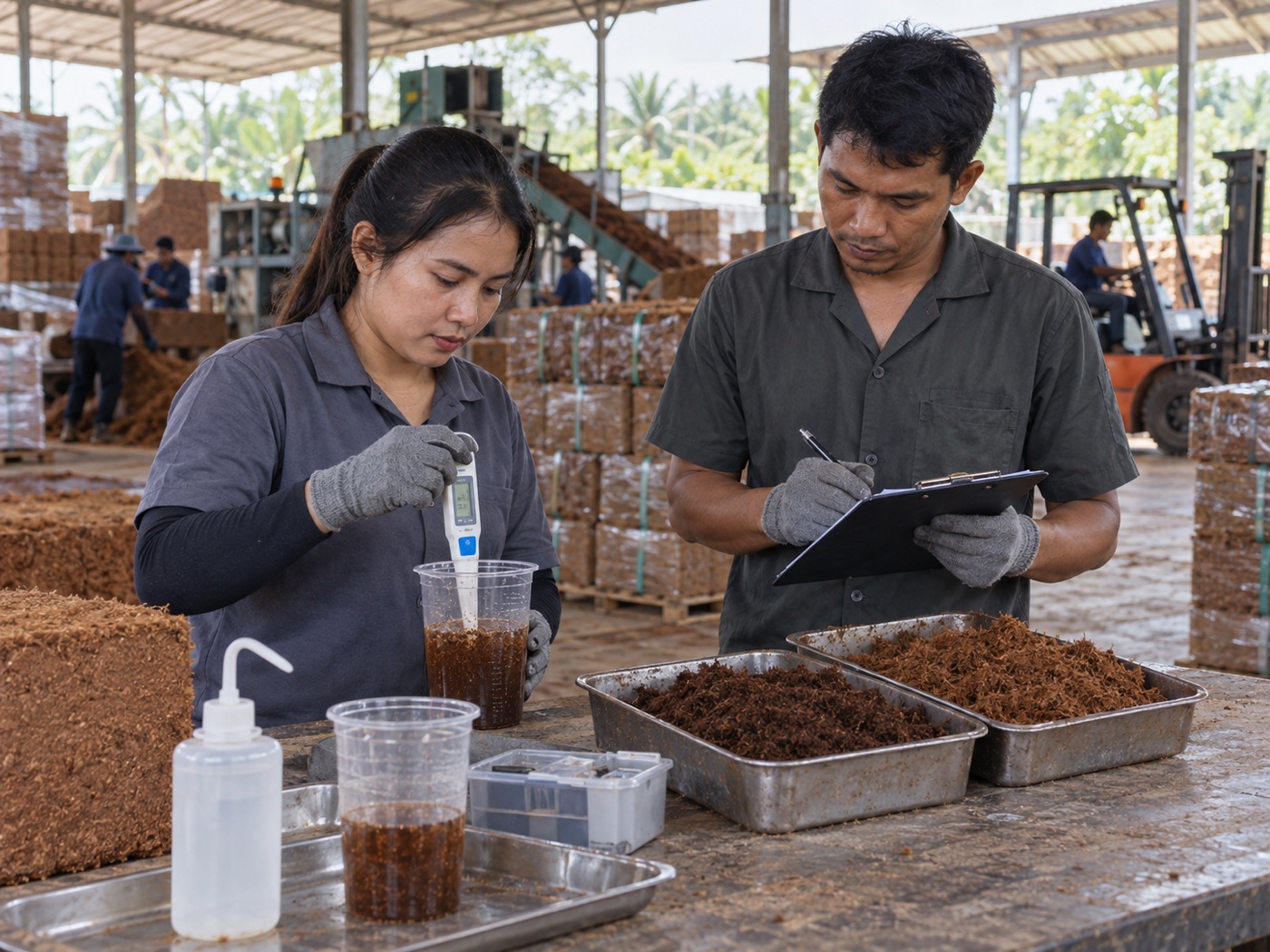
For professional growers and substrate buyers, cocopeat quality is not defined by a single good sample. It is defined by whether the next batch performs like the last one. Reliable cocopeat should arrive with predictable salinity, moisture, particle structure, expansion, and packaging condition so growers can manage irrigation and nutrition with confidence.
That is why quality control matters at every stage, from incoming coconut material to the final shipment. CocoX focuses on cleaner, low-EC coir and on the practical controls that help reduce variation between batches.
Reliability begins with consistent raw material
Coconut origin, husk maturity, storage, weather exposure, and initial processing can all influence the final substrate. A sound quality-control program therefore begins before washing or compression. Incoming material should be checked for contamination, excessive mineral load, decomposition, moisture condition, and the balance of pith, fibre, and chips required for the intended grade.
Controlling these inputs is important because later processing cannot fully correct every structural difference. Separating grades and maintaining clear batch identity helps preserve the physical characteristics growers expect.
EC and pH must be measured, not assumed
Electrical conductivity is one of the most important checks for horticultural cocopeat because it indicates the level of soluble salts in the test extract. pH also affects nutrient availability and root-zone management. Both values should be measured using a documented preparation and extraction method, since results from different test methods are not directly comparable.
CocoX uses its NanoFilter approach to reduce the salt burden in coconut coir and targets ultra-low-EC material for demanding horticultural applications. Testing remains essential: representative batch samples should confirm that the processed material matches the product specification before release. Buyers should always ask which test method was used when comparing EC figures from different suppliers.
Physical performance is part of quality
A low EC result alone does not guarantee a suitable growing medium. Particle-size distribution influences air-filled porosity, water retention, drainage, and the stability of the root zone. Moisture content affects compressed weight, expansion behaviour, and shipping efficiency.
Depending on the product format, a professional release check may also cover expansion volume, bulk density, fibre or chip percentage, water-holding behaviour, and the condition of compressed blocks or grow bags. The exact checks should match the agreed product specification and crop application rather than relying on one universal recipe.
Representative sampling protects batch consistency
Testing is only meaningful when the sample represents the batch. Samples should be taken from appropriate points in the production lot, identified clearly, and linked to the corresponding production and packing records. Keeping batch identity through processing makes it easier to investigate variation and compare one shipment with the next.
This traceability is particularly valuable for importers, substrate blenders, and commercial growers who need repeatable performance across multiple deliveries. It turns quality from a visual promise into information that can be checked and discussed.
Packaging and pre-shipment inspection complete the process
Even correctly processed cocopeat can be compromised by damaged packaging, poor storage, moisture ingress, incorrect labels, or unstable pallet preparation. Final inspection should therefore confirm the product grade, package condition, quantity, identification, and shipment readiness before loading.
What professional buyers should request
- A clearly defined product specification
- The EC and pH test method used
- Representative batch test information
- Particle-size and moisture controls relevant to the grade
- Traceable batch and packaging identification
- Pre-shipment confirmation against the purchase specification
Reliable cocopeat is the result of controlling variation, measuring the properties that matter, and communicating results clearly. CocoX combines low-EC processing with a quality-focused approach designed to give professional growers and buyers greater confidence in every shipment.
Contact CocoX to discuss the appropriate cocopeat grade, physical structure, testing requirements, and packaging format for your crop or market.