
Cocopeat is valued by professional growers for its balanced air-to-water ratio, low bulk density, and reliable root-zone structure. However, preparing cocopeat correctly before planting is essential for consistent nutrient management. One important preparation step is buffering.
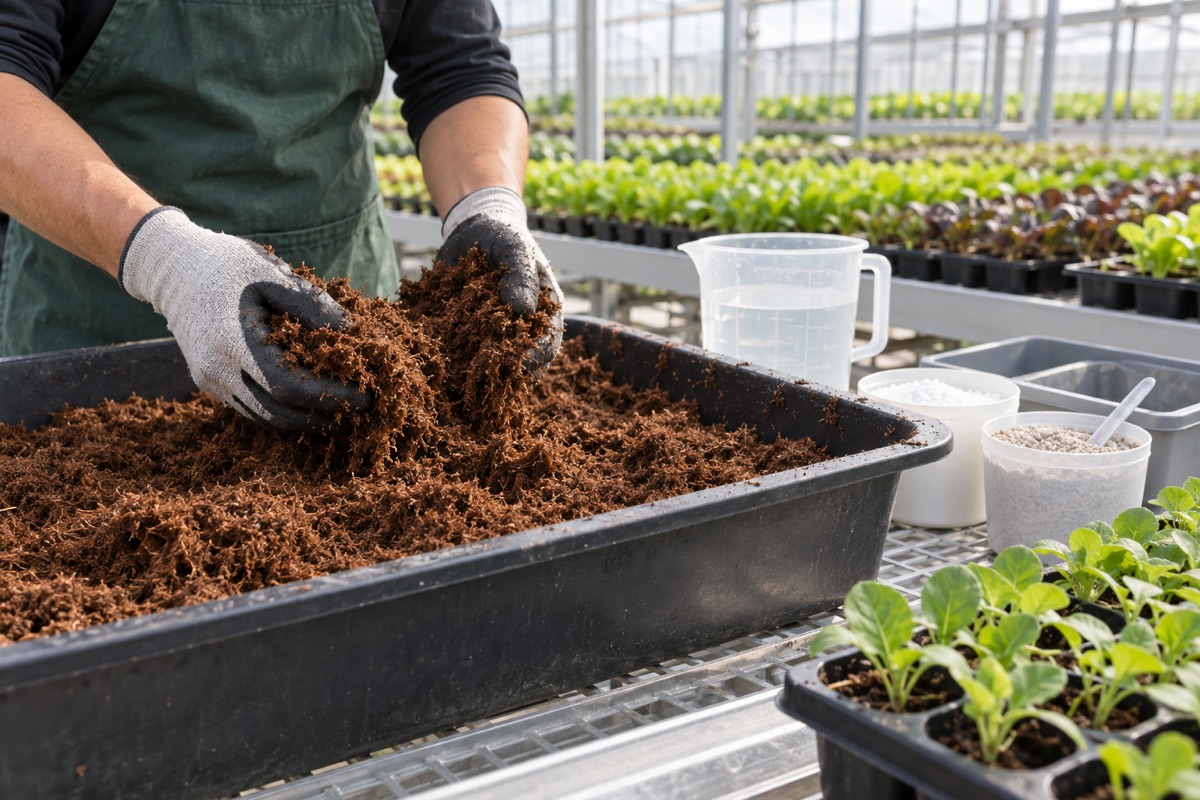
What Does Buffering Cocopeat Mean?
Buffering is a controlled treatment that helps manage the natural cation exchange behavior of coconut coir. Cocopeat can hold positively charged nutrients on its exchange sites. When untreated material is first exposed to a nutrient solution, those sites may retain calcium and magnesium while releasing other elements such as potassium or sodium.
A proper buffering process preloads the exchange sites with calcium, and often magnesium, before the substrate is used for production. This makes the root-zone chemistry more predictable and helps the crop receive the nutrient balance intended by the grower.
Why Buffering Matters
Well-buffered cocopeat can support more stable crop establishment, especially in hydroponic systems, nurseries, propagation programs, and container production. The main benefits include:
- More reliable calcium availability: Calcium is important for cell development, root growth, and the strength of new plant tissue.
- Improved magnesium management: Magnesium supports chlorophyll formation and photosynthesis.
- Better control of potassium and sodium: Appropriate washing and buffering reduce the risk of unwanted ions interfering with the feeding program.
- More consistent electrical conductivity: A prepared substrate gives growers a clearer starting point for irrigation and fertigation decisions.
- Faster, more uniform establishment: Young roots benefit from a stable environment during the sensitive early stages of crop growth.
Washing and Buffering Are Different
These two processes are often confused. Washing removes soluble salts from the cocopeat and lowers its initial electrical conductivity. Buffering addresses the exchange sites within the coir structure. A product may be washed but not buffered, so growers should always check the product specification and preparation instructions.
For demanding horticultural applications, both low salt levels and appropriate buffering are important. Testing the incoming material for EC, pH, sodium, potassium, calcium, and magnesium provides useful information before planting.
A Practical Buffering Workflow
The exact recipe should be adapted to the crop, water quality, substrate specification, and fertilizer program. A typical professional workflow follows these principles:
- Hydrate the cocopeat evenly. Expand compressed material completely and break up compacted sections so the treatment can reach the whole volume.
- Check the starting EC and pH. This establishes a baseline and shows whether additional washing is required.
- Apply a calcium-based buffering solution. Some programs also include magnesium. Use measured concentrations based on agronomic guidance rather than estimating by appearance.
- Allow sufficient contact time. Uniform saturation and adequate time are necessary for the exchange process to occur throughout the substrate.
- Drain and rinse as required. Remove excess solution while avoiding unnecessary over-washing.
- Test the prepared substrate. Verify EC and key nutrient levels before transplanting valuable crops.
Growers should use clean water, calibrated meters, suitable personal protective equipment, and recommendations from their agronomist or nutrient supplier. The goal is not simply to add fertilizer, but to create a stable starting medium that matches the intended fertigation strategy.
When Pre-Buffered Cocopeat Makes Sense
Pre-buffered cocopeat can save labor and reduce variation for commercial farms that need repeatable results across many containers, slabs, or grow bags. It is especially useful when transplant schedules are tight or when on-site water and testing facilities are limited.
Even with a pre-buffered product, growers should review the supplier’s analysis and confirm that the material is suitable for the crop. Buffering requirements can differ between tomatoes, peppers, cucumbers, berries, ornamentals, and young plants.
Start with the Right Cocopeat Specification
Successful cocopeat cultivation begins with more than particle size alone. Source quality, washing, buffering, EC, pH, air-filled porosity, water-holding capacity, and consistency between batches all influence root-zone performance.
CocoX supplies cocopeat growing media for professional horticulture and hydroponic production. By choosing the right specification and preparing the substrate carefully, growers can build a more stable foundation for healthy roots, efficient nutrient delivery, and consistent crop development.