
Cocopeat is often described as one growing medium, but in practice its texture can vary a lot. Fine cocopeat pith, coarser fiber, and larger coco chips each behave differently around plant roots. For growers, understanding particle size is one of the simplest ways to choose a substrate that matches the crop, container, and irrigation system.
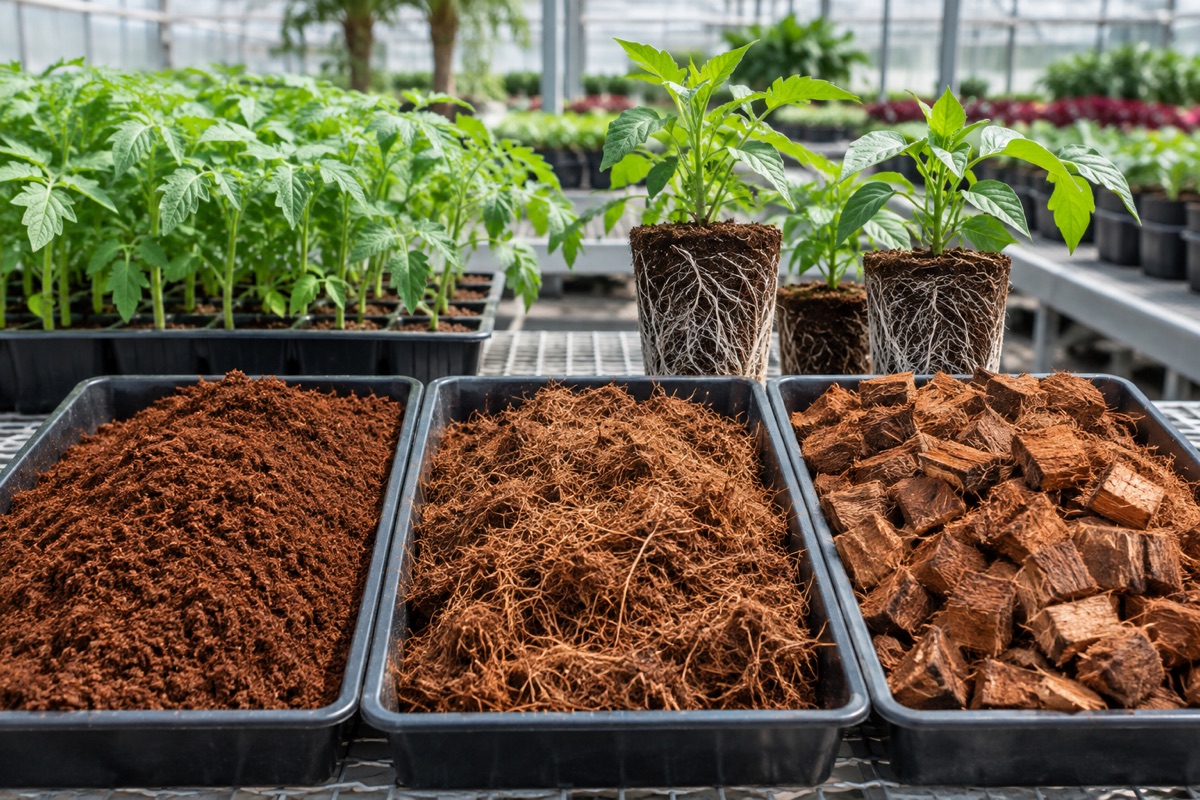
Fine Cocopeat Pith: Moisture and Root Contact
Fine cocopeat pith has a soft, sponge-like structure that holds water well and creates close contact around young roots. This makes it useful for seedling production, plug trays, propagation, and crops that need steady moisture during early growth.
Because fine particles retain more water, growers should pay attention to drainage and irrigation frequency. In the right system, fine cocopeat can help reduce moisture stress and support uniform establishment.
Coco Fiber: Better Air Movement and Structure
Coco fiber adds structure to a mix. It helps prevent the substrate from becoming too compact and improves air movement through the root zone. This is important because healthy roots need oxygen as well as water and nutrients.
For many nursery and horticulture applications, a balanced blend of pith and fiber can offer a practical middle ground: enough water retention for stable growth, with enough porosity to keep roots active.
Coco Chips: Drainage for Larger Containers
Coco chips are larger pieces of coconut husk. They create bigger air spaces and improve drainage, making them useful for larger containers, ornamentals, orchids, aroids, and crops that do not like a constantly wet root zone.
When blended with cocopeat pith, chips can help growers adjust the physical performance of the substrate without moving away from coconut coir as the base material.
Choosing the Right Blend
The best cocopeat texture depends on how the crop is grown. Seedlings may need finer material for moisture consistency. Hydroponic or fertigation systems may need a stable balance of water holding and air space. Larger potted plants may benefit from coarser structure and faster drainage.
CocoX focuses on consistent Thai coconut coir processing so growers can select growing media with more predictable performance. By matching particle size to the crop and system, growers can build a healthier root environment and achieve more reliable results.